Quick answer: A retort machine is a pressure vessel that sterilises food in pouches or cans at around 121 degrees Celsius. For entrepreneurs, however, the choice between buying your own retort machine and using a retort service depends on production volume, capital, premises space and how ready you are to manage food safety SOPs.
This guide is for sellers of sambal, rendang, curry, sauces and other dishes who want products that last without a fridge. So we explain how a retort machine works, the different types, the cost factors, and when a retort service makes more sense at the start. Besides that, we run a retort machine in Wangsa Melawati every week ourselves, so everything here comes from real operations.
What a retort machine is and how it works
A retort machine is a stainless steel chamber that closes tightly. First, the team seals the food in pouches, arranges the packs in baskets or racks and loads them into the chamber. Then water or steam heats the chamber under pressure. Because of this pressure, the temperature can rise above 100 degrees Celsius, which is high enough to kill bacterial spores in low-acid foods.
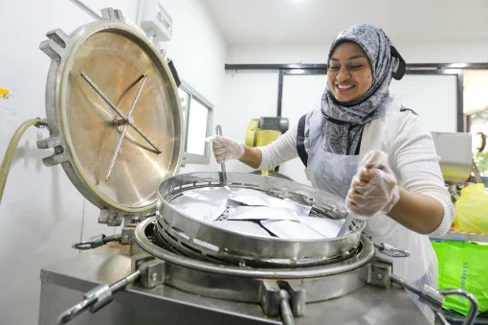
One cycle usually has three phases:
- Come-up. First, the machine heats the chamber to the target temperature.
- Hold. Then the machine holds the temperature and pressure for the time set for each recipe.
- Cool. Finally, cold water flows in while the operator controls the pressure, so the pouches do not swell or burst.
At MakanHubb, for example, our cycles run at 121 degrees Celsius and around 1.5 bar, with a capacity of up to 110 packs per cycle.
Types of retort machine
| Type | How it heats | Suits |
|---|---|---|
| Water immersion | Pressurised hot water fully covers the packs | Soft pouches, even heat |
| Water spray | Nozzles spray hot water over the packs | Pouches and plastic containers, uses less water |
| Steam | Direct saturated steam | Cans and glass jars |
| Steam-air | A mix of steam and pressurised air | Packs that need outside pressure control |
In terms of shape, vertical machines are smaller and cheaper, while horizontal machines with trolleys suit large production. In addition, rotary machines suit thick products, so the heat reaches the centre of the pack faster.
Retort machine cost factors
Prices vary widely by capacity, material, control system and supplier. So instead of giving one number that may not fit your situation, we list the things that decide the real total:
- Chamber capacity and number of baskets. A bigger chamber costs more, although the cost per pack is lower.
- Control system. Manual control is cheaper. On the other hand, PLC control with a temperature recorder makes audits and consistency easier.
- Heat source. Steam machines also need a separate boiler, which adds cost and inspection requirements.
- Pressure vessel approval. In Malaysia, pressure vessels are subject to inspection by the Department of Occupational Safety and Health (JKKP). For this reason, ask the supplier about the documents and registration.
- Support equipment. You also need a pouch sealer, scales, racks, trolleys, a cold water system and lab tests.
- Utilities. Besides that, you pay electricity, water and gas bills for every cycle.
- Training and process validation. In addition, you have to test every recipe to find a safe time and temperature.
First, get quotes from at least three suppliers. Then ask them to list what the price covers: delivery, installation, training, warranty and spare parts. Local media have also reported on retort entrepreneurs who received support from government agencies, so check for equipment assistance programmes open in your area.
Buy your own retort machine or use a retort service?
Many entrepreneurs, however, buy a machine straight away before the product has proven it can sell. Instead, we suggest testing the market first.
| Item | Own retort machine | Retort service |
|---|---|---|
| Upfront capital | High | Low, pay by weight |
| Schedule control | Full | Based on available slots |
| Premises space | Needs space, water, electricity and drainage | Not needed |
| Technical skills | Needs a trained operator | The service provider handles it |
| Suits | Steady daily production | Product testing, small batches, seasonal orders |
One simple way to decide: work out how many kilograms you retort each month. Then multiply that by the retort service cost and compare it with the machine instalment, operator salary, utilities and maintenance. So if the service cost is still lower, there is no reason to rush into buying a retort machine.
What you need before you start retorting
- Suitable premises. First, you need floors that are easy to wash, drainage, a clean water supply and enough electricity.
- Written SOPs. After that, write SOPs that run from receiving raw ingredients to quarantining finished products.
- Records for every cycle. Also log the time, temperature, pressure, batch number and operator name.
- Product testing. Incubate samples and check for swelling or leaks before selling. At MakanHubb, for example, we quarantine every batch for 7 days.
- Complete labels. Finally, show the product name, ingredients, net weight, expiry date and producer details.
Common mistakes new retort entrepreneurs make
- Using the original recipe without changes. Because the food cooks again in the machine, shorten the first cooking time and adjust the thickness.
- Overfilling the pouch. As a result, heat takes longer to reach the centre, and oil can easily contaminate the seal.
- Dirty seals. Oil or sauce left on the mouth of the pouch causes leaks.
- No quarantine. The seller sells products straight away without an observation period.
- Assuming every pack will succeed. Even when you follow the SOP, a small share of pouches can fail. So build a spoilage rate into your cost calculation.
How to use the MakanHubb retort service
If you are not ready to buy a retort machine yet, our service can help:
- RM17.50 per kilo, minimum charge RM70 for up to 4kg
- Slots Wednesday to Saturday, 11am to 5pm
- Deliver the food frozen and labelled
- Wait 7 to 14 days after retorting before eating or selling
First, estimate the price and check which foods are suitable on our retort service page. Also, for the basics of the process, read our guide to retort food.
FAQ about the retort machine
How much does a retort machine cost?
The price depends on capacity, heating type, control system and supplier. So get written quotes from several suppliers and make sure each quote states the costs of installation, training and pressure vessel inspection.
Can I use a home pressure cooker as a retort machine?
We do not recommend it for products you sell. A home pressure cooker does not have accurate temperature control and records. Besides, cooling without pressure control can damage the pouches.
How long is one retort cycle?
It depends on the pack size, type of food and the machine. In addition, the time includes come-up, hold and cooling. For this reason, you have to test every recipe.
Do I need a licence to use a retort machine?
In most cases, JKKP registers and inspects pressure vessels. Food premises are also subject to the requirements of the local authority and the Ministry of Health. So check the current requirements before buying.
What is the difference between a retort service and OEM?
With a retort service, you cook the food yourself and we only retort it. With OEM, however, the factory produces the whole product for your brand.
Which foods are not suitable for retort?
Crispy or battered fried food, leafy vegetables that break down easily, and food that is too thick. Also, you can find the full list on our retort service page.
Still have questions?
WhatsApp the MakanHubb team at 012-540 0263. We reply during office hours, Monday to Friday.